 Wei-Lin Dai Group
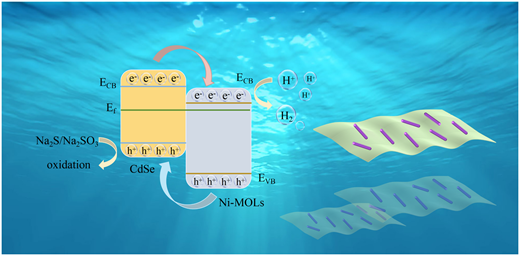
Photocatalytic hydrogen evolution represents a sustainable and eco-friendly strategy for hydrogen production, yet its efficiency is fundamentally limited by the high-rate recombination of photo-induced electron–hole pairs. Constructing heterojunctions is a pivotal strategy to overcome this limitation. In this study, we report a novel binary heterojunction composed of CdSe nanorods and Ni-based metal–organic layers (Ni-MOLs) nanosheets, fabricated via an in situ solvothermal approach. A series of CdSe/Ni-MOLs composites (denoted as CNM-x) were prepared. The optimized CNM-0.5 exhibited a high hydrogen evolution rate of 10.77 mmol·g−1·h−1, which was 38 and 160 times higher than that of pristine CdSe and Ni-MOLs, respectively. Meanwhile, the optimized photocatalyst demonstrated excellent stability over five consecutive cycles, together with an apparent quantum efficiency (AQE) of 7.3% (350 nm). In situ and ultrafast spectroscopic analyses coupled with density functional theory (DFT) calculations systematically elucidate the synergistic mechanism within the type-II heterojunction. The intimate interfacial coupling between CdSe and Ni-MOLs induces favorable charge redistribution, establishes a robust built-in electric field, and drives directional electron transfer from CdSe to Ni-MOLs active sites with a prolonged carrier lifetime, effectively suppressing charge recombination and lowering the Gibbs free energy for hydrogen adsorption. This study underscores the potential of dimensionally matched heterostructures in suppressing charge recombination and provides strategic insights into the rational design of MOLs-based systems for efficient solar-driven hydrogen production.