 Wei-Lin Dai Group
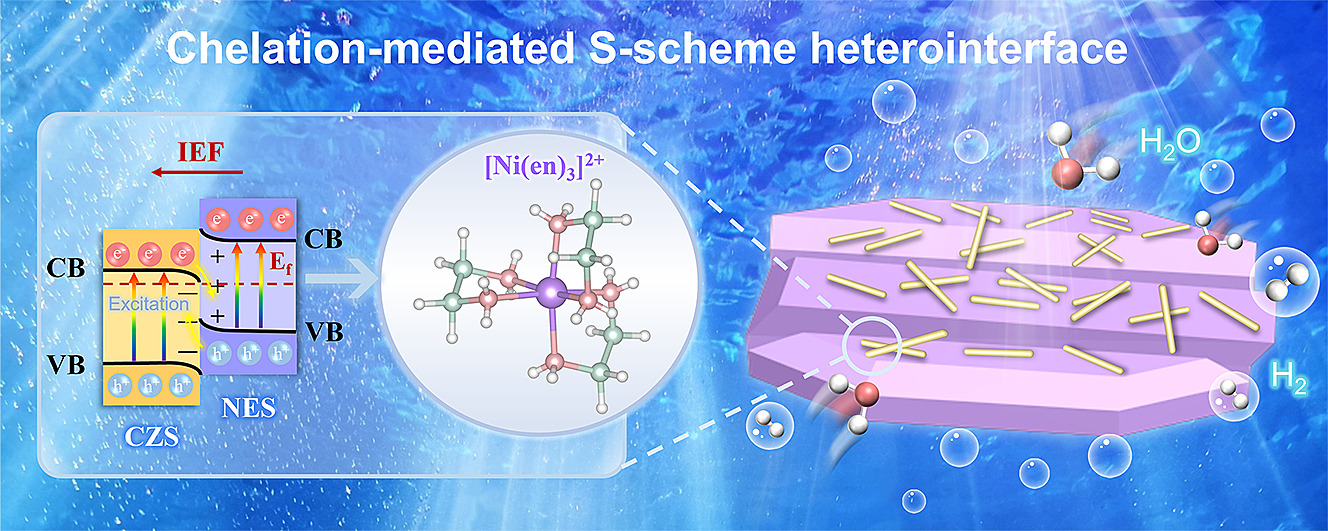
Noble-metal-free photocatalysts that combine high activity with long-term durability remain scarce for solar hydrogen production. Transition-metal coordination complexes possess highly tunable electronic structures and chelation-stabilized configurations, yet their use as intrinsic interfacial components for regulating charge dynamics remains underexplored. Herein, an S-scheme Cd0.3Zn0.7S/[Ni(en)3]S2O3 heterojunction was constructed through an in situ solvothermal strategy, in which the bidentate-chelated octahedral Ni complex [Ni(en)3]S2O3 acts as an interfacial electronic modulator. The optimized Cd0.3Zn0.7S/[Ni(en)3]S2O3 photocatalyst delivered an H2 evolution rate of 46.53 mmol·g−1·h−1 under visible light irradiation, 3.3 times that of Cd0.3Zn0.7S and higher than that of 1 wt% Pt-loaded Cd0.3Zn0.7S. It also exhibited enhanced photostability and an apparent quantum efficiency of 18.6% at 350 nm. In situ irradiated X-ray photoelectron spectroscopy (ISI-XPS), femtosecond transient absorption spectroscopy (fs-TAS) and density functional theory (DFT) calculations revealed that the robust heterointerface induces spontaneous electron migration from [Ni(en)3]S2O3 to Cd0.3Zn0.7S, establishing interfacial band bending and a built-in electric field for S-scheme charge transfer. This work demonstrates that chelation-stabilized complexes can serve as effective electronic regulators at semiconductor interfaces, providing a versatile strategy for constructing active, stable, and noble-metal-free photocatalysts for solar hydrogen production.