 Wei-Lin Dai Group
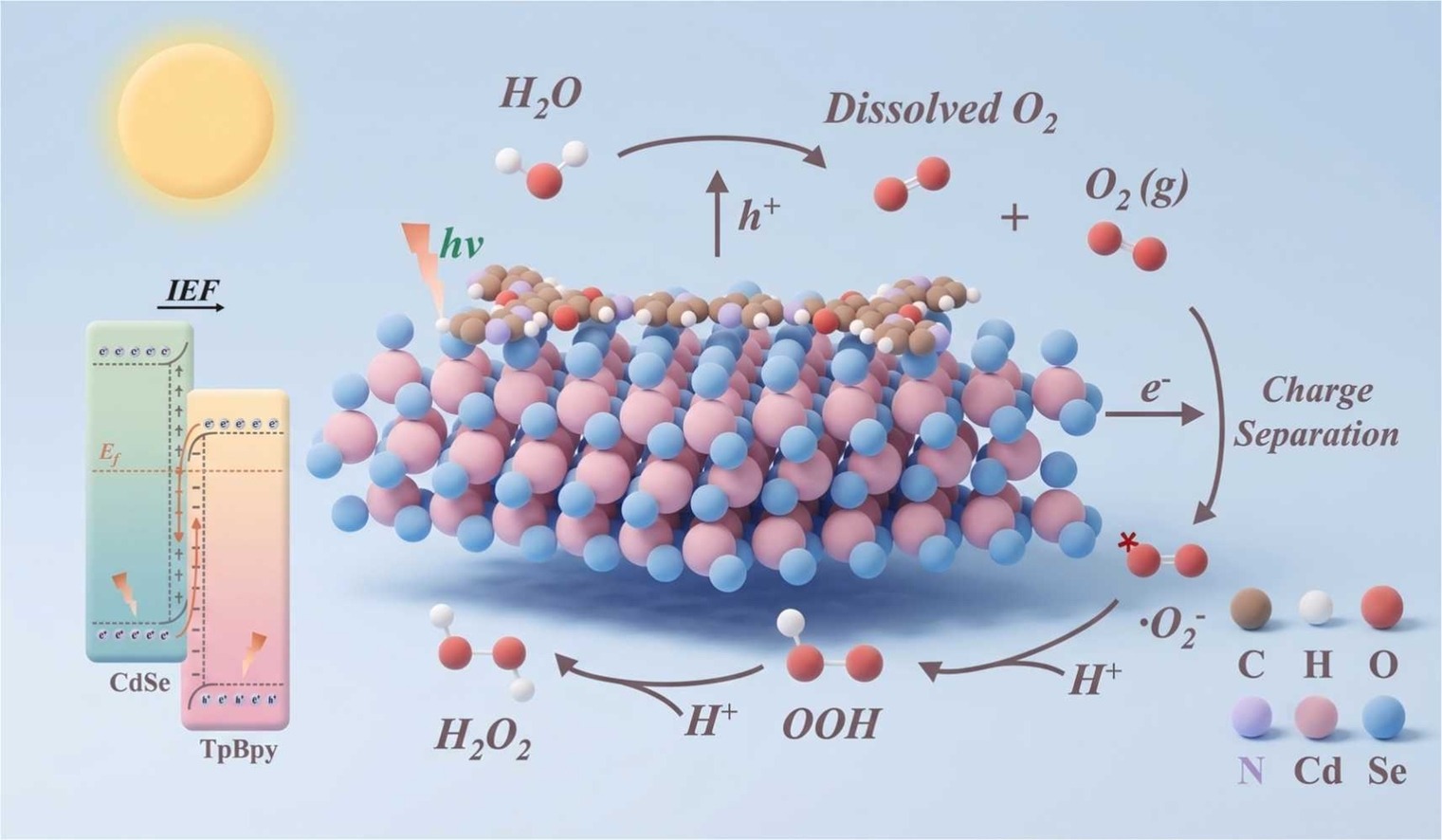
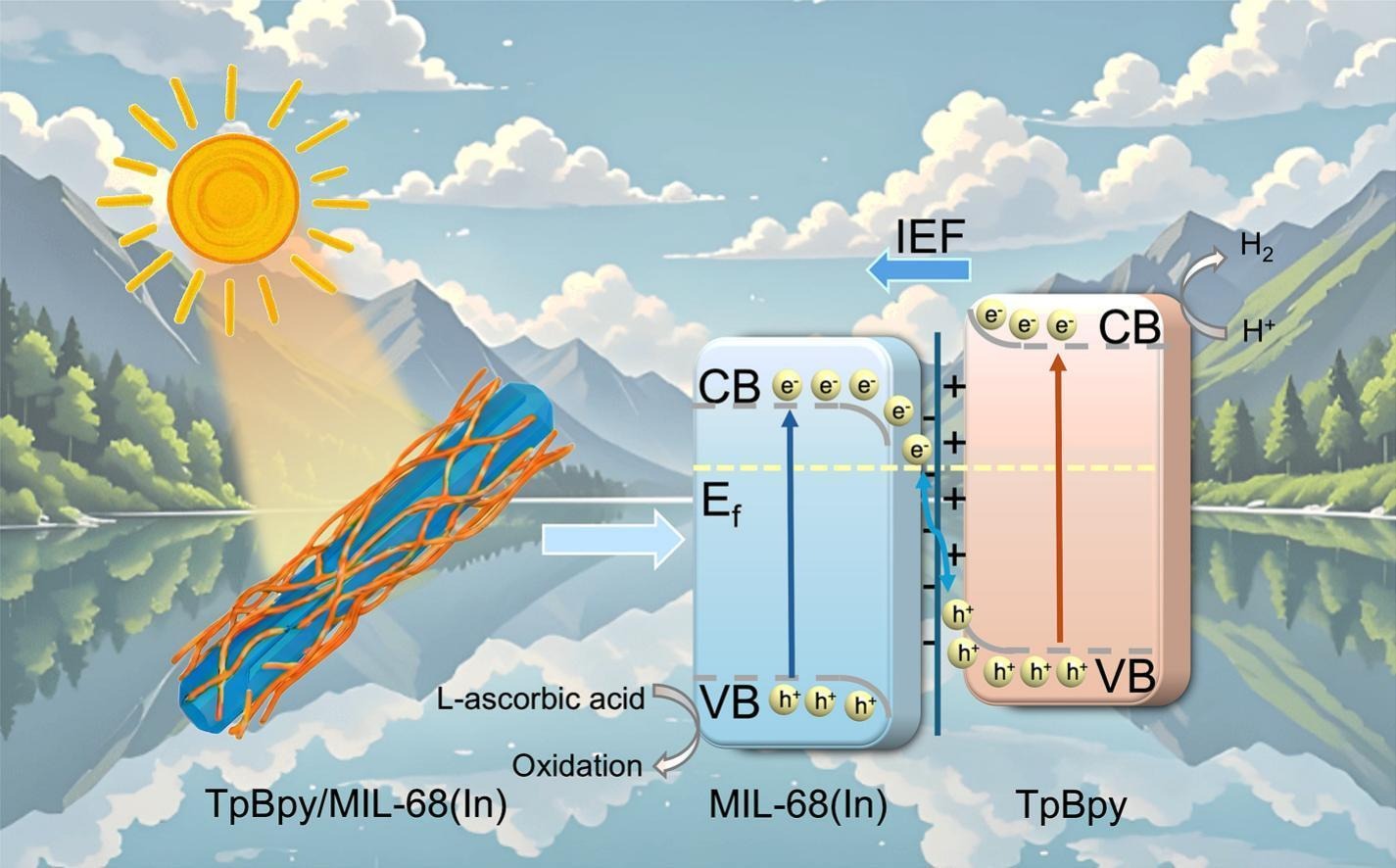
Photocatalytic H2O2 production via oxygen reduction represents a sustainable pathway for solar-to-chemical energy conversion. However, constructing sacrificial-agent-free heterojunctions that simultaneously maximize charge separation and preserve redox ability remains a significant challenge. Herein, we report a molecular-level interfacial engineering strategy to anchor COF-TpBpy onto CdSe nanorods via in-situ solvothermal growth, fabricating a strongly coupled organic–inorganic S-Scheme heterojunction. Benefiting from the intimate inter facial contact, the optimized 10CdSe/TpBpy composite achieves a remarkable H2O2 yield of 4349 μmol⋅g−1·h−1 in pure water without any sacrificial agents, alongside an impressive apparent quantum yield (AQY) of 11.1% at 450 nm. Mechanistic investigations, combining Density Functional Theory (DFT) calculations, Kelvin probe force microscopy (KPFM), and in-situ irradiated X-ray photoelectron spectroscopy (in-situ XPS), visually confirm a robust built-in internal electric field (IEF) driven by the work function difference. Furthermore, femtosecond transient absorption (fs-TA) spectroscopy reveals an ultrafast picosecond-scale interfacial charge transfer behavior, providing direct kinetic evidence for the S-Scheme mechanism. This unique charge transfer pathway effectively preserves the strong reducing electrons in the CdSe conduction band to boost the oxygen reduction reaction (ORR) kinetics. This work offers a viable paradigm for designing robust hybrid S-Scheme architectures for efficient photocatalysis.