 Wei-Lin Dai Group
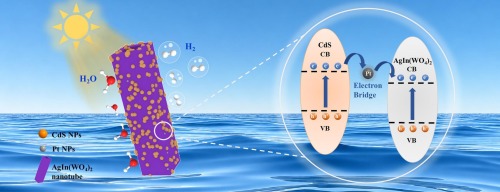
Solar-driven photocatalytic water splitting offers a promising route for sustainable hydrogen production. Herein, a ternary CdS/Pt/AgIn(WO4)2 photocatalyst was fabricated via hydrothermal synthesis followed by in situ photoreduction. The optimized CdS/Pt/AgIn(WO4)2 catalyst achieves a visible-light-driven hydrogen evolution rate of 6.54 mmol·g−1·h−1, approximately 30 and 5 times higher than those of pristine AgIn(WO4)2 nanotubes and CdS nanoparticles (CdS NPs), respectively. Combined structural characterizations and theoretical analyses confirmed the formation of a strongly coupled CdS/Pt/AgIn(WO4)2 interface. Interfacial Pt nanoparticles (Pt NPs) acted as electron mediators, facilitating directional electron transfer from CdS NPs to AgIn(WO4)2 and promoting charge separation. Density functional theory (DFT) calculations reveal that the hydrogen adsorption Gibbs free energy (ΔGH*) is close to the thermoneutral value, thereby reducing the thermodynamic barrier for hydrogen evolution. The synergistic effect of interfacial charge transfer and accelerated surface reaction kinetics significantly enhances the photocatalytic hydrogen evolution performance of the CdS/Pt/AgIn(WO4)2 heterostructure. This study provides an effective strategy for developing high-performance CdS-based photocatalysts for solar hydrogen production.