 Wei-Lin Dai Group
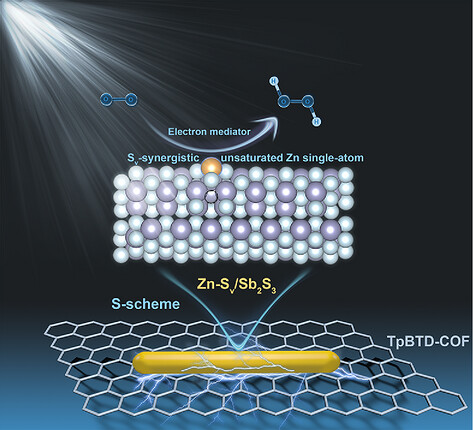
Solar-driven H2O2 production presents a sustainable alternative to the energy-intensive anthraquinone process, yet remains limited by inefficient charge transfer and poor selectivity. Herein, a synergistic strategy combining the atomic defect engineering and interfacial microenvironment modulation is established, which involves the in-situ mechanical growth of β-ketoenamine-linked covalent organic framework (TpBTD-COF) onto Zn single-atom-anchored sulfur-vacancy (Sv)-rich Sb2S3 nanorods (Zn-Sv/Sb2S3@TpBTD) to overcome the above limitations. The optimal Zn-Sv/Sb2S3@TpBTD-3 photocatalyst achieves a remarkable non-sacrificial H2O2 production rate of 2692 µmol·g−1·h−1 with 90% selectivity in pure water, significantly outperforming most single-atom photocatalysts. Advanced characterizations and theoretical calculations indicate that the Sv-synergistic unsaturated Zn atomic sites as electron mediator under the internal electric field of S-scheme heterojunction optimizes the interfacial electron transfer and promotes O2 adsorption, significantly improving activity and selectivity for H2O2 photosynthesis. This work offers an innovative perspective on the synergistic integration of defect engineering, single-atom catalysis, and heterojunction design for modulating the interfacial charge dynamics, enabling scalable solar-to-chemical energy conversion applications.