 Wei-Lin Dai Group
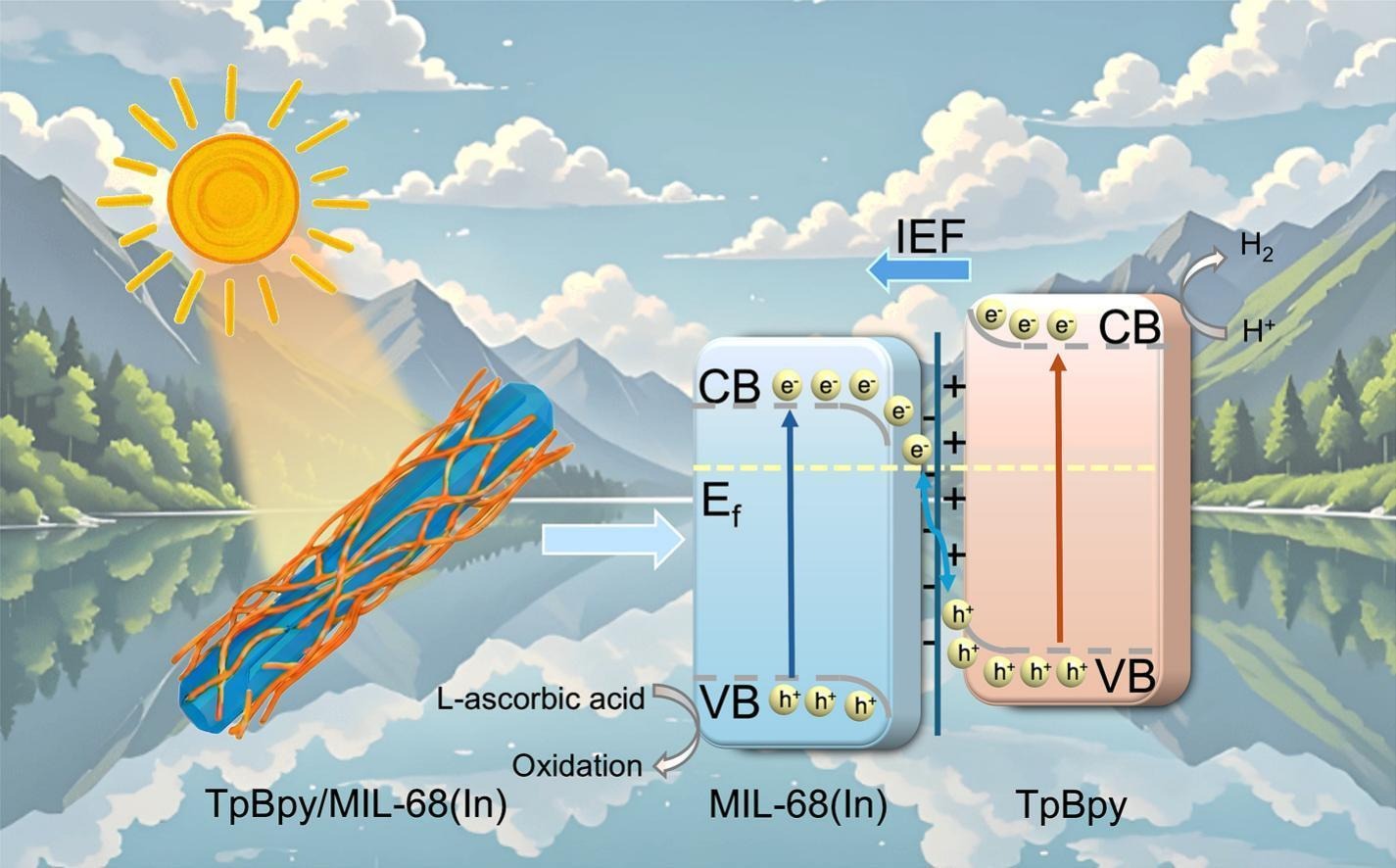
Engineering high-efficiency S-scheme heterojunctions with robust interfacial charge transfer channels is critical for simultaneously achieving spatial charge separation and preserving the strong redox potential of photogenerated carriers. Herein, we report the successful construction of a novel covalently integrated TpBpy/MIL-68(In) S-scheme heterostructure via an in situ solvothermal strategy. Uniquely, MIL-68(In) nanorods function as dynamic quasi-templates, in which partial structural dissolution orchestrates an in situ self-etching process to guide the epitaxial growth of TpBpy via Schiff-base condensation. This dynamic evolution transforms simple two-dimensional physical contact into a three-dimensionally interlocked covalent interface, thereby maximizing the effective contact area. The optimized covalently integrated heterostructure exhibits an enhanced photocatalytic hydrogen evolution rate of 13.7 mmol g−1·h−1 under simulated sunlight, representing a remarkable enhancement of 68.5-fold and 1.9-fold compared to pristine MIL-68(In) and TpBpy, respectively. Furthermore, combined in situ irradiated XPS and DFT calculations provide direct evidence for the interfacial electron cloud redistribution induced by chemical bonds. These robust covalent bridges establish a strong built-in electric field (IEF) and continuous low-impedance channels, effectively circumventing the high contact resistance and severe charge recombination typical of physically mixed systems. This work provides a meaningful paradigm for the interfacial engineering of metal-organic framework (MOF)/covalent organic framework (COF) based covalent heterojunctions to achieve advanced solar-to‑hydrogen conversion.