 Wei-Lin Dai Group
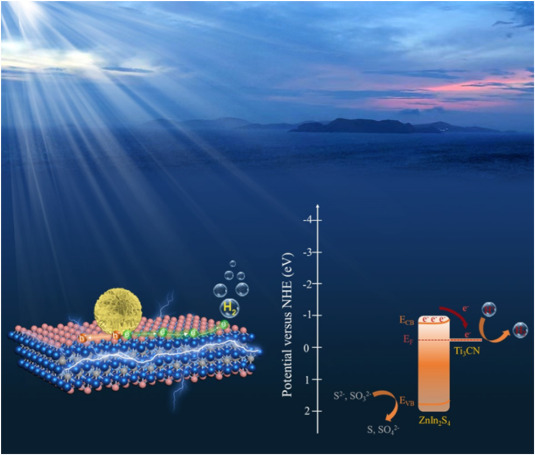
Overcoming rapid charge carrier recombination and restricted visible-light harvesting in single-component photocatalysts remains a formidable challenge for efficient solar-to-hydrogen conversion. In this work, an in situ self-assembly strategy is employed to construct a high-performance heterojunction by integrating zinc in dium sulfide (ZnIn2S4) nanoflowers with non-Ti3C2-type titanium carbonitride (Ti3CN) MXene nanosheets. The optimized 3 wt% Ti3CN/ZnIn2S4 composite exhibits a remarkable visible-light-driven hydrogen evolution rate of 603.3 μmol g-1·h-1, which represents a 2.4-fold enhancement over pristine ZnIn2S4 while maintaining excep tional cyclic stability. Ultra-violet photoelectron spectroscopy analysis and Density functional theory calculations reveal that the higher work function of Ti3CN (4.58 eV) compared to ZnIn2S4 (4.07 eV) drives upward band bending at the interface, thereby establishing a robust built-in electric field. This tailored architecture facilitates ultrafast, directional electron injection from ZnIn2S4 to the Ti3CN matrix, effectively suppressing charge recombination. Furthermore, the Ti3CN component serves as a superior electron sink where the calculated Gibbs free energy of hydrogen adsorption (ΔGH*) is optimized to 0.21 eV, leading to a significantly reduced reaction overpotential. This study provides a robust strategy for the rational design of MXene-based heterojunctions and offers a solid foundation for green hydrogen production in large-scale renewable systems.