 Wei-Lin Dai Group
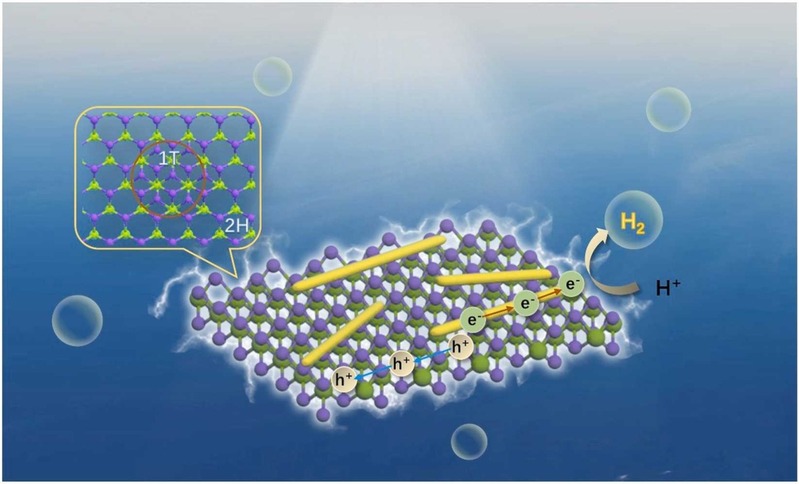
This study underscores the critical role of phase engineering in boosting the photocatalytic hydrogen evolution performance of MoSe2-based heterostructures. The metallic (1T) and semiconducting (2H) phases of MoSe2 were rationally synthesized and integrated with CdZnS nanorods to construct a 1T/2H-MoSe2/CdZnS hybrid photocatalyst. The optimized composite exhibits an exceptional H2 evolution rate of 44.9 mmol·g-¹ ·h-¹ , representing a 5.4-fold enhancement over pristine CdZnS and significantly outperforming the 2H-MoSe2/CdZnS control. Comprehensive spectroscopic, electrochemical, and density functional theory (DFT) analyses reveal that this superior activity arises from the synergistic effects of the 1 T phase, including enhanced electrical conductivity, a narrowed bandgap, and an abundance of catalytically active sites. These features collectively promote visible-light absorption and facilitate the efficient separation of photogenerated electron–hole pairs. Ultraviolet photoelectron spectroscopy (UPS) and DFT calculations further corroborate the formation of an S-scheme charge transfer pathway at the heterojunction interface, which enables spatial separation of redox potentials and accelerates interfacial electron transfer. Notably, the 1T/2H-MoSe2 surface exhibits an optimized hydrogen adsorption free energy, approaching the thermoneutral ideal for proton reduction. This work not only provides fundamental insights into phase-dependent interfacial charge dynamics but also establishes a rational design strategy for precious-metal-free photocatalysts capable of efficiently converting solar energy into chemical fuels.